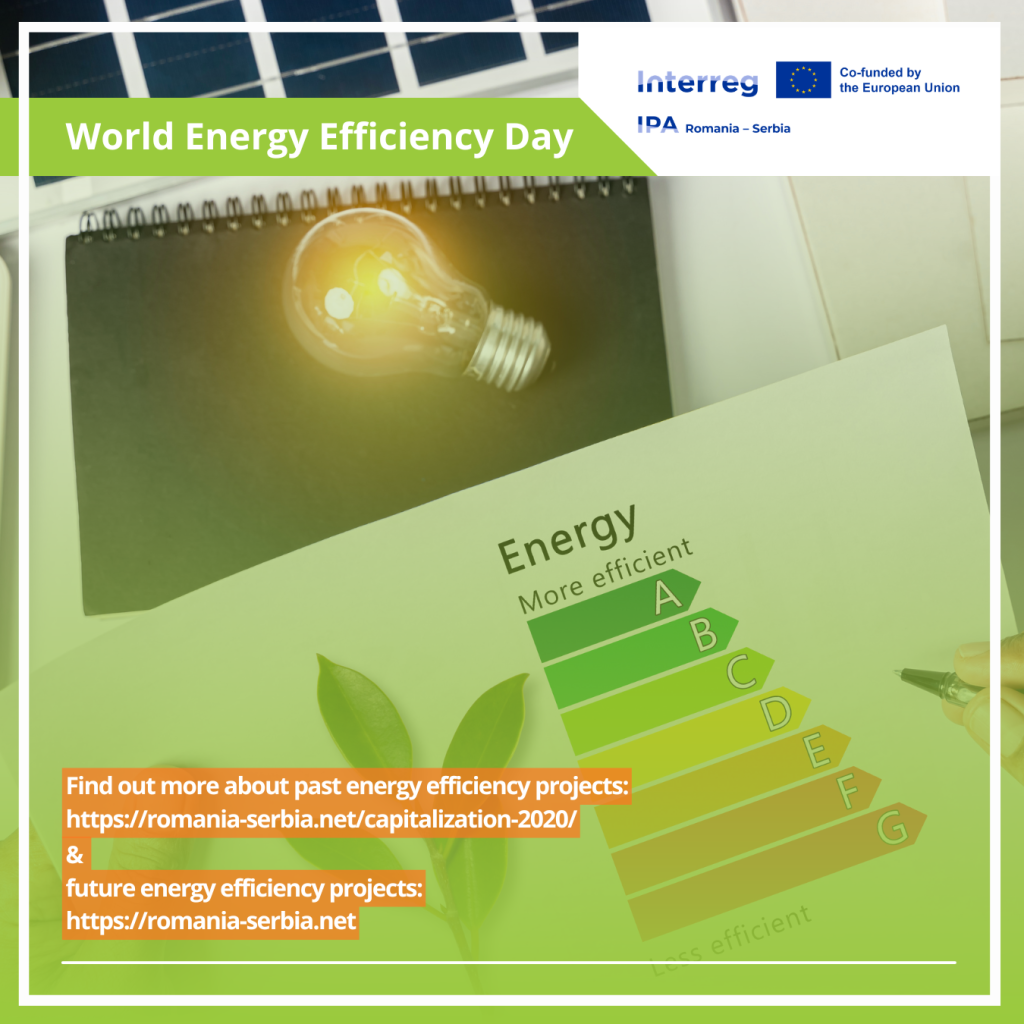
Every 5th of March, World Energy Efficiency Day reminds us of the EU’s ambitious goal to cut energy use by 11.7% by 2030.
This year, we are celebrating how our cross-border initiatives between Romania and Serbia have turned this strategic priority into reality.
By working together, our communities are using smart lighting, powering up with the sun, and building a sustainable legacy.
The Power of Partnership in Numbers, co-funded by the European Union through the Interreg-IPA Cross-border Cooperation Romania-Serbia Programme (2014-2020):
- 💡 Total Illumination: Thousands of smart LEDs in Recas, Plandiste, Lenauheim, and Zagubica have slashed energy waste by up to 70%.
- ☀️ Solar Revolution: Over a dozen public sites now use solar collectors, including Resita’s Olympic Swimming Basin and key buildings in Drobeta-Turnu Severin and Kladovo.
- 🏢 Smart Infrastructure: Zrenjanin is now home to the region’s first “Smart Building” and the Regional Centre for Energy Efficiency.
- 🛣️ Greener Connections: Over 3km of roads around Kikinda were rehabilitated with solar lighting for safer, cleaner travel.
- 🎓 Community Power: 7,000+ participants joined workshops and eco-camps to lead the green transition.
- 💰 Investment: Over €6 million dedicated to a greener future.
The journey doesn’t stop here! 🚀 A new chapter is unfolding. Under the Interreg IPA Romania-Serbia Programme (2021-2027), we are currently contracting a fresh wave of energy efficiency initiatives. Stay tuned as we light the way for the next generation!
Discover our success stories:
💡Energy Efficiency – The Premise of a Better Environment in Romania – Serbia Cross-Border Area
e-MS Code: RORS-13
Total budget: €1.353.167,55
Partners: Resita Municipality, Romania; City of Pancevo (Serbia).
What have the partners achieved together?
☀️ Solar Power: The Swimming Olympic Basin in Resita was fitted with solar panels to tap into clean energy.
🚴 Green Travel: A brand-new bike rental system in Resita is making it easier (and cleaner) to get around.
🏢 Smarter Buildings: In Pancevo, the Regional Sports Hall was fitted with top-tier insulation and modern heating to stop energy waste in its tracks.
💡 Smart Urban Services Through Homogenous Quality Standard in Public Infrastructures for Higher Energy Efficiency (BANATSMART)
e-MS Code: RORS-36
Total budget: €1.631.506,80
Partners: Municipality of Plandiste (Serbia); Municipality of Recas (Romania); Timis County Energy Management Association (Romania); Regional Agency for Socio-Economic Development Banat (Serbia).
Lighting the way for World Energy Efficiency Day: Public lighting can account for up to half of a local council’s electricity bill, but this cross-border project between Recas (Romania) and Plandiste (Serbia) proves there is a brighter way forward. By replacing outdated lamps with modern LED systems and smart monitoring, the project has helped these municipalities slash their energy consumption and costs. It wasn’t just about new bulbs, though; the initiative also brought together over 200 people for workshops to share best practices on saving energy and exploring renewable sources. This collaboration shows that by working together across borders, communities can build a more sustainable future and keep the streets bright without wasting power.
💡 Smart And Sustainable Energy Consumption (SASEC)
e-MS Code: RORS-300
Total budget: €852.001,51
Partners: City of Zrenjanin (Serbia); Municipality of Timisoara (Romania); Regional Agency for Socio-Economic Development Banat (Serbia); Romanian Sustainable Energy Cluster ROSENC (Romania).
Energy efficiency is about more than just saving power; it’s about smart planning and long-term management. To mark World Energy Efficiency Day, we are highlighting a cross-border project that has laid the groundwork for a sustainable future in the Banat region.
The initiative successfully launched the region’s first “Smart building,” which now serves as the headquarters for the Regional Centre for Energy Efficiency. This hub features a “demo room” where visitors can see energy-saving technology in action.
The project’s key achievements include:
🏢 Innovation: Rehabilitating a building into a modern, energy-smart facility.
📋 Strategy: Developing a Sustainable Energy Action Plan and a Best Practice Guidebook.
🤝 Engagement: Reaching nearly 5,000 people through awareness events and training over 700 individuals in sustainable resource use.
By establishing a dedicated Energy Efficiency Platform and a network for research, this project ensures that local communities have the tools and knowledge to reduce their environmental impact for years to come.
💡 Green economy for greener local communities in Danube area (The greener Danube)
e-MS Code: RORS-363
Total budget: €504.378,00
Partners: Municipality of Kladovo (Serbia); Municipality of Drobeta-Turnu-Severin (Romania).
Reducing emissions requires both smart technology and community action. This project between Drobeta-Turnu Severin (Romania) and Kladovo (Serbia) shows exactly how it’s done by combining renewable energy with local skills. By establishing a joint Energy Hub and a strategic framework for the region, the initiative has delivered real, practical results for the region:
☀️ Solar Energy: 12 public locations across both cities are now equipped with solar energy collectors.
💡 Efficient Lighting: 120 modern lamps have been installed in Kladovo to slash energy waste.
🎓 Skills for the Future: The project has trained 40 people in green energy technology and hosted an eco-camp for 60 young people to inspire the next generation of environmental ambassadors.
From studying the potential of biomass to creating “energy passports” for public buildings, these neighbouring communities are proving that cross-border cooperation is the key to cutting greenhouse gas emissions.
💡 Rehabilitation and Modernization of the Public Lighting System Lenauheim – Zagubica (RMPLS)
e-MS Code: RORS-425
Total budget: €989.578,00
Partners: Lenauheim Commune (Romania); Municipality of Zagubica (Serbia).
For World Energy Efficiency Day, we are spotlighting how Lenauheim (Romania) and Zagubica (Serbia) have modernised their streets to save energy and taxpayer money. By ditching old, inefficient bulbs for sleek LED technology and energy-saving pillars, these communities have slashed their energy consumption and CO2 emissions.
What makes this project shine?
🖥️ Smart Management: A new telematics system allows the municipalities to monitor and manage the entire lighting grid remotely and efficiently.
🚗 Safety First: Better visibility means safer roads and more comfortable neighbourhoods for residents.
🌱 Community Spirit: Over 360 local people took part in awareness campaigns to learn how these changes protect their environment.
It’s a brilliant example of how upgrading basic infrastructure can lead to massive wins for the planet and the local budget.
💡 Improvement of Banat Connectivity 2 (IBC2)
e-MS Code: RORS-481
Total budget: €1.144 022,12
Partners: PE “Roads of Serbia”; Municipality of Jimbolia (Romania); Municipality of Kikinda (Serbia); RDA Banat (Serbia).
Infrastructure is the backbone of any economy, but this project proves it can be green, too. By rehabilitating over 3 kilometres of vital road networks and installing 280 solar-powered streetlights, the initiative has made cross-border travel safer, smoother, and more sustainable.
Why does this matter for energy efficiency?
⚡ Off-grid Power: Using solar energy for public lighting significantly reduces the demand on the local electricity grid.
🛣️ Smarter Transit: Improved road surfaces and better border connectivity help reduce transit times and vehicle idling, cutting down on wasted fuel.
🌱 Community Awareness: More than 1,000 participants took part in events to learn about environmental preservation and sustainable development.